
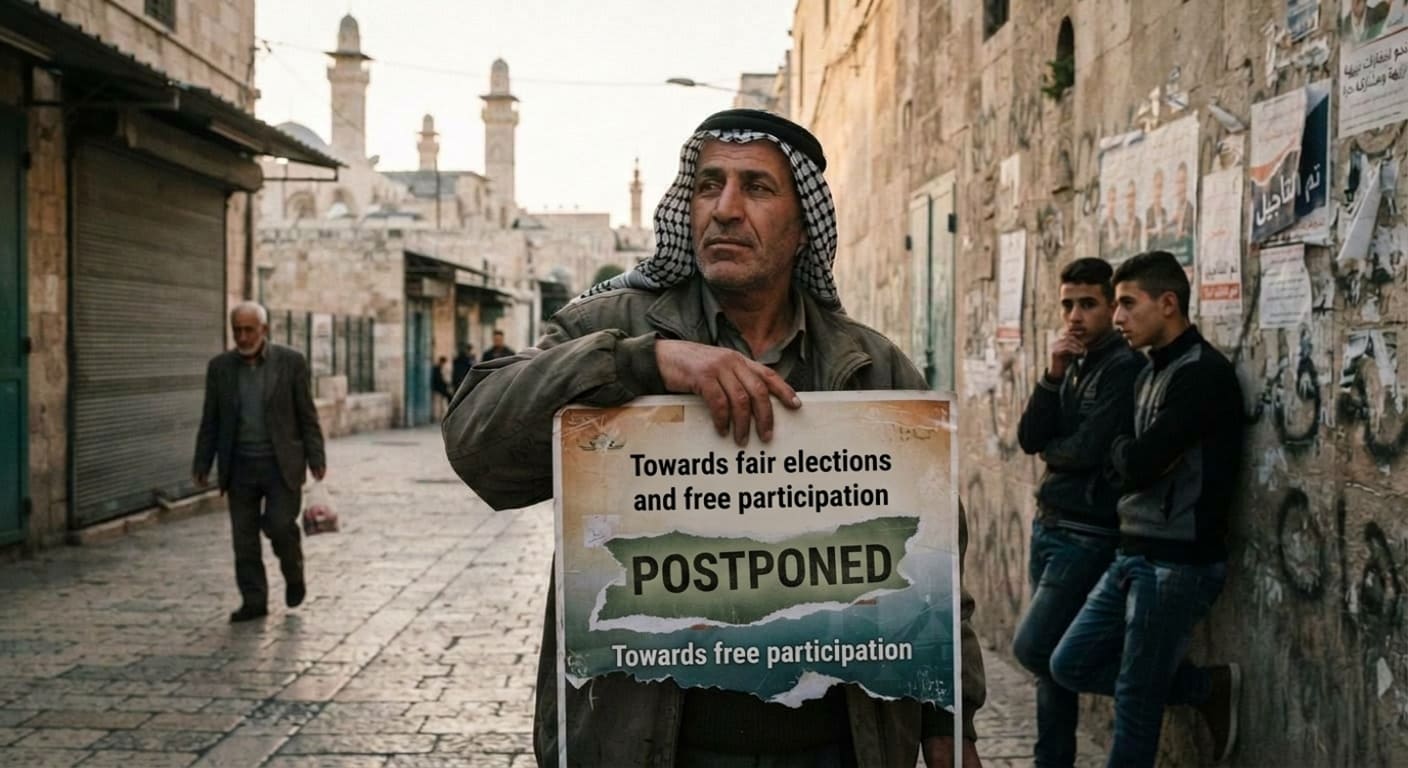

In his article, Mr. Hani Al-Masri argues that postponing the Palestinian legislative elections has effectively become a foregone conclusion, with the remaining questions revolving around when and how the decision will be announced.
Although the final statement of the Fatah Revolutionary Council reaffirmed that the elections would be held as scheduled, it made this conditional on the occupying state refraining from imposing obstacles that would prevent them from taking place. Nevertheless, Al-Masri notes that postponement was the prevailing position at the meeting.
“The prevailing assessment,” he writes, “is that the decision to postpone the elections has effectively been made.” The debate has therefore shifted to the timing and manner of the announcement: whether it will come before or after the opening of candidate-list registration, and whether a new date will be set for March, a year or two later, or left open-ended.
Al-Masri outlines two possible routes. The Central Elections Commission could declare that the elections cannot be held without the necessary Israeli facilitation, including the transfer of ballot boxes and indelible ink, guarantees for the freedom of movement and work of the Commission and local and international observers, an end to assassinations, an easing of the blockade, and a halt to attacks by Israeli forces and settlers in the West Bank.
Alternatively, postponement could emerge as an outcome of a national dialogue in Cairo, with its fate determined following the President’s scheduled visit on the 16th of this month and the possible inclusion of national dialogue on the agenda.
Cairo, however, remains hesitant to convene such a dialogue. As Al-Masri explains, it does not want the process to end either without an agreement or with an agreement that is never implemented. Its next step will therefore depend on the meeting with the President.
Why Postpone the Elections?
According to what has been conveyed from the President, Al-Masri writes, the postponement is driven by the opposition of both the US administration and the Israeli government to holding the elections.
Washington, he argues, is aligning itself with Israel’s position because it does not want an elected Palestinian Legislative Council competing with Trump’s Board for authority and jurisdiction over the Gaza Strip.
As for Tel Aviv, Al-Masri argues that Israel’s most extreme government in history has no interest in elections that could strengthen and renew the legitimacy of a Palestinian Authority it is seeking to undermine. A new Legislative Council, he notes, would reunite the West Bank and Gaza, embody a unified Palestinian identity, and keep open the possibility of establishing a Palestinian state. He adds that the Israeli government considers “burying the possibility of establishing such a state” one of its most significant achievements.
Why Not Challenge the US-Israeli Decision?
Al-Masri poses a central question: “Why not challenge the US-Israeli decision and expose who is truly behind the postponement?”
He identifies several reasons. First, the Palestinian leadership wants to avoid confrontation, relying instead on what he describes as a strategy of survival and waiting, removing pretexts, and keeping its distance from direct confrontation.
Second, the Palestinian Authority and Fatah are not in their strongest positions and fear losing the elections. This concern is particularly significant if Marwan Barghouti remains outside Fatah’s official electoral list, as he could then support or head another list and run in the presidential elections.
Al-Masri also points to the possibility of a broad electoral list being formed with the support of Hamas, the Current, Islamic Jihad, and others. If established, he argues, such a list could pose a serious challenge and reshape the balance of power within the Legislative Council.
Barghouti’s Initiative
Al-Masri places the initiative of imprisoned leader Marwan Barghouti within this wider political context. Adopting it, he argues, would require time and would therefore inevitably lead to postponement.
Bringing all Fatah groups together on a single electoral list would require unifying the movement, reinstating those who have been expelled, and holding a unifying conference, as stipulated in the initiative. Rejecting it, meanwhile, would only add to the existing complications.
Postponement as the Lesser of the Available Options
Al-Masri suggests that postponement, after challenging the US-Israeli rejection of the elections, may be the lesser of the available options, but only if it forms part of a broader political agreement
He insists that a new date must be set for legislative and presidential elections, as well as elections to the Palestinian National Council wherever possible. The international community must also be called upon to fulfil its responsibilities by providing guarantees for free and fair elections and ensuring that their results are respected.
In Al-Masri’s view, elections should take place on the eve of ending the occupation and achieving independence. He warns that elections held under occupation risk granting it legitimacy, making the Palestinian objective appear to be the preservation of the Authority and its leadership, and improving living conditions under occupation, rather than ending the occupation itself.
He further stresses that postponement must be part of a comprehensive package that includes ending what he calls the “theatre” of appointing members of the Palestinian National Council through the so-called “constituency system theatre.”
Such a package must also include agreement on a national project capable of confronting challenges and making use of available opportunities. This, he writes, should encompass a social contract, a national programme, appropriate strategies for achieving it, and unified national leadership.
“Palestinians have more in common than what divides them,” Al-Masri writes, arguing that elections should serve as a tool for confronting the occupation and as an expression of pluralism and competition within a shared national framework, without excluding anyone, levelling accusations of treason or apostasy, or allowing any party to monopolize truth, patriotism, or religion.
A Broad and Representative National Dialogue
For national dialogue to differ from previous rounds of dialogue and agreements, Al-Masri argues, participation must be widened beyond representatives of political factions.
He calls for a process that also includes representatives of different Palestinian communities and sectors, young people, women, Palestinians in the diaspora, civil society, the private sector, and independent public figures.
In doing so, he emphasises the need for a more inclusive national dialogue that reflects the diversity of Palestinian society and brings its various constituencies into the discussion over the country's political future.
Note: This is not a literal, word by word translation of the original article. It is an English adaptation that conveys all of the original article’s ideas and follows its argument and sequence. Direct quotations are taken from the original article.